The difference between Automatic, Semi-Automatic, and Manual Capsule Filling Machines
Capsule filling machines are some of the most in-demand tools in the pharmaceutical sector. Most consumers prefer capsules over tablets for medications, which is reflected in the industry’s enormous demand for capsules. In turn, this has also contributed to the booming business of the capsule filling machine manufacturers. If you are looking for capsule filling machines, there are three major types to choose from. These are automatic, semi-automatic, and manual machines. Each of them has its advantages, and it can be a little hard to choose the right one when you aren’t fully aware of their features. This article will give you all the differences between these machines and their respective advantages. This will allow you to make a better decision when choosing one for your firm.

Automatic Capsule Filling Machines

Automatic Capsule Filling Machines are the most efficient for large businesses as they can fill several gelatin capsules with the medicine at once. They also have high accuracy, irrespective of whether they are filling powder, granules, or pellets. These machines are great for improving production speed and reducing labor costs at the same time. Let’s take a quick look at automatic capsule filling machines work.
Working Process
Before dwelling on the functioning of the machine, it is essential to know its parts. The automatic capsule filler comes in two varieties – intermittent motion and continuous motion type. Since intermittent motion machines are the most common ones in the market, we will discuss the design and working of these. The machine has a core that includes the round filling station. This carries out the following processes:
- Capsule rectification and separation from bodies
- Filling medication
- Rejecting wasted capsules
- Locking the capsules
- Ejecting and cleaning the filled capsules
Design
The automatic capsule filling machines have several parts that help them function. It has a programmable microcontroller, which is then connected with a touch-enabled display. The machine includes a 3-phase power supply to deliver the juice for performing efficiently with several precise dosing tools. It also consists of a capsule filter and computer vision-based logic that helps reject failed capsules.
Application
The machine can fill up to 90,000 capsules in one hour with a high level of accuracy. The machine can encompass a variety of gelatin capsules in various combinations. All these features make it a bread-winning tool for any pharmaceutical firm.
Semi-Automatic Capsule Filling Machine

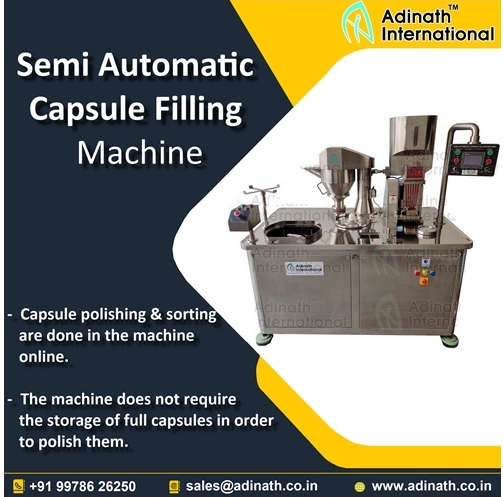
The semi-automatic capsule filling machines are essential for manufacturing line-ups requiring precise tools for pharmaceutical procedures. This machine allows for a higher degree of freedom and automation when compared to manual variation. These machines can yield high production outputs ranging from 25,000 to 47,000 capsules an hour. They can perform operations such as line, polishing, and sorting the capsules quite efficiently. Let’s dwell a little deeper into how they function.
Working Process
The working of the semi-automatic machine is a lot similar to the automatic variant. It performs the operations in the following order:
- Feeding empty capsules in the hopper
- Putting the loading ring on
- A worker would then push the lever to load the capsules into the ring and manually separate the capsule body and caps.
- The lower part then needs to be placed in the loading ring, and the filling needs to be placed in the hopper.
- The power button then needs to be pressed to fill the capsules.
- Then the worker would need to close the capsule body and cap and send it for sealing.
- After sealing, the machine would eject the filled capsules.
Design
The semi-automatic machine comes with a capsule loading system that can be controlled by a worker. This is then operated with the human-machine interface, which includes a similar microcontroller for powering a touch-enabled display. The machine also has a capsule polishing system that can remove dust particles with its vacuum and brush bristles.
Applications
This machine has a very high production rate and can perform various operations without any operator. It is excellent for firms looking for machines that can match high production demands while minimizing labor and power costs. The machine is also safe to handle and offers easy upgrades for the future.
Manual Capsule Filling Machine
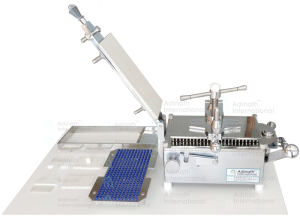
The manual capsule filling machine is ideal for firms that need to meet small-batch demands for pharmaceuticals. The machine can work well with a hand-powered filler that can fill and lock all hard-gelatin capsules. The capsules that it fills have a high success rate to ensure minimum wastage. It can produce up to 300 capsules in each cycle, and the speed depends on the operators. Let’s take a look at how they function.
Working Process
The manual machine’s working process is quite simple, and it involves filling the capsules with a hand-operated procedure. The steps involved are as follows:
- Placing capsules in the filler after separating the caps and bodies
- Filling the powder by turning the handle and compressing
- Covering the capsules by pulling a lever to pull the cover down
- Removing the capsules that have been sealed
Design
The design of the manual machine is quite simple in the essential sense. It has two levers to control the filler hand and the sealer. The machine is quite sturdy and can be used without any electricity at all. This also makes it easier to sterilize the machine with liquids and makes cleaning it more comfortable.
Application
The machine can be used in various clinical applications. It can produce up to 6,000 capsules in an hour, which makes it quite sufficient for most small firms such as clinical research, ayurvedic and homeopathic production. The machine also costs less and has no power requirements.
Hopefully, with the above information, you will make a more informed decision about which machine is right for your purpose.
FAQ of Difference in Automatic, Semi-Automatic & Manual Capsule Filling Machines
Which type of capsule filling machine is best for small-scale production or start-ups?
Manual capsule fillers are best for R&D, clinical trial batches, herbal products and start-ups because they cost the least and are simple to use. As demand grows, a semi-automatic machine is a sensible next step before moving to a fully automatic model.
How many capsules can each type of machine fill per hour?
Output varies by model and capsule size. Manual machines typically fill a few thousand capsules per hour, semi-automatic machines roughly 10,000 to 25,000, and automatic machines tens of thousands to several lakh per hour. Check the exact specification of the model you plan to buy.
Which capsule filling machine gives the most accurate fill weight?
Automatic machines generally give the most consistent fill weight because dosing is fully mechanized and controlled. Semi-automatic and manual machines can also be accurate with good design, such as a dosing disc or flute design, but results depend more on operator skill and powder properties.
When should I upgrade from a semi-automatic to an automatic capsule filling machine?
Consider upgrading when demand outgrows your current output, labor costs rise, or you need tighter weight consistency and compliance documentation. If operators are spending most of their time loading and unloading capsules, an automatic machine usually pays back through higher output and fewer errors.
How does the cost of manual, semi-automatic and automatic machines compare?
Manual machines have the lowest purchase price, semi-automatic machines sit in the middle, and automatic machines require the highest investment. However, automatic machines often cost less per capsule at high volumes because they need less labor and waste less material. Compare total lifetime cost, not just the purchase price.
Do semi-automatic and manual capsule filling machines need skilled operators?
Manual machines are simple but still need trained operators to keep fill weights consistent. Semi-automatic machines need basic training on dosing adjustments and capsule loading. Automatic machines need less manual effort but benefit from trained technicians for setup, changeovers and maintenance.
Are all three types of capsule filling machines cGMP compliant?
Compliance depends on how the machine is designed and built, not only on its automation level. Look for easy-to-clean construction, suitable materials, dust control and supporting documentation. Adinath’s capsule filling machines are cGMP and CE compliant. Always ask your supplier for the relevant certificates.
Can the same capsule filling machine handle different capsule sizes?
Most machines can handle multiple capsule sizes by changing the size-specific parts, such as the tooling, bushes or change parts. The ease and time of changeover vary by model, so confirm the supported capsule sizes and changeover procedure before purchase.
How do I choose the right capsule filling machine for my business?
Consider your production volume, budget, capsule sizes, product type, compliance needs and available labor. Choose manual for small batches, semi-automatic for growing production, and automatic for large-scale output. A supplier that offers all three types can recommend the best fit without bias.