Description
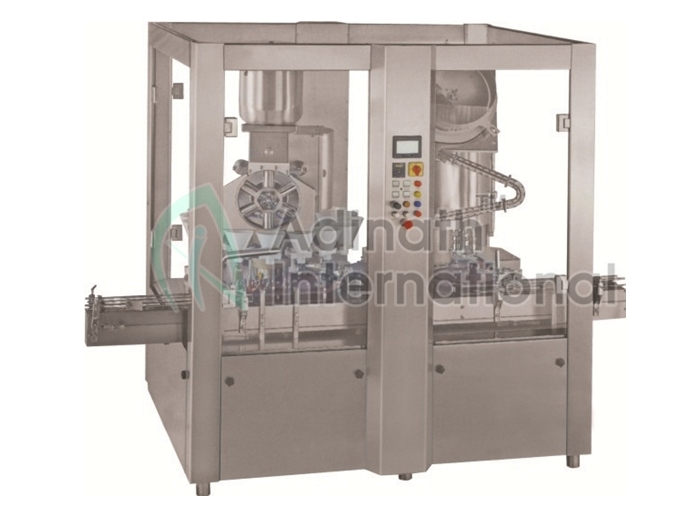
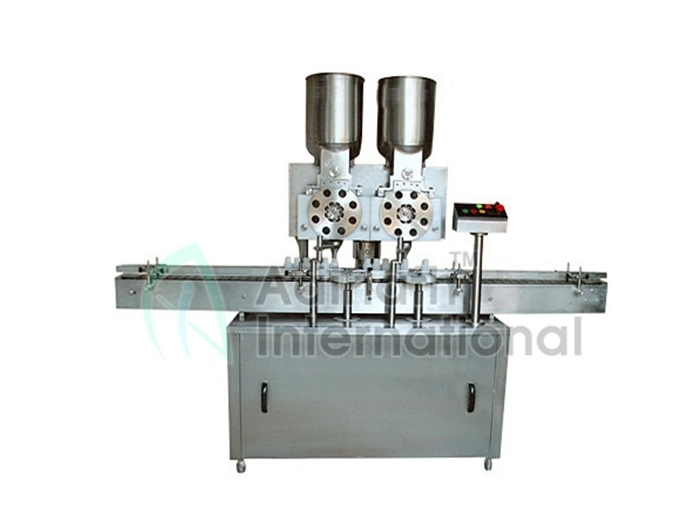
Automatic Injectable Powder Filling & Rubber Stoppering Machine having eight ports in a powder wheel. The precision built welded steel frame is encompassed with stainless steel sheets with access doors for servicing the machine. Adinth offers two models in this machine, first is Automatic Single Wheel Injectable Powder Filling & Stoppering Machine which provides output up to 7000 vials/hour and second is Automatic Double Wheel Injectable Powder Filling & Stoppering Machine provides output up to 14000 vials/hour. All contact parts made for Good house keeping and complies as per current good manufacturing practice (cGMP).
The Injectable Powder Filling Machine ensures accuracy, sterility, and efficiency in pharmaceutical production. Designed for sterile powders, this machine meets stringent industry standards and integrates seamlessly into high-demand manufacturing environments.
Advanced Design and Build Quality
Built with a compact, cGMP-compliant design, the Injectable Powder Filling Machine features stainless steel contact parts for sterility and durability. Its modular construction simplifies maintenance, while the compact layout saves valuable production floor space.
The machine uses advanced vacuum and pneumatic systems to transfer powder with minimal loss. This ensures product integrity and eliminates contamination risks, making it suitable for sensitive pharmaceutical applications.
Multi-Stage Powder Filling Process
The Injectable Powder Filling Machine operates through a carefully designed multi-stage process to ensure precision:
- Vial Feeding: Sterilized vials are fed into the system via an infeed conveyor.
- Powder Dosing: Volumetric dosing ensures accurate filling for powders with uniform densities.
- Rubber Stoppering: A built-in unit seals vials with rubber stoppers to maintain sterility.
*Each stage is programmable, which guarantees flexibility for different batch sizes and powder types.
High Throughput and Accuracy
Capable of processing up to 120 vials per minute, the Injectable Powder Filling Machine is ideal for large-scale production. It delivers filling accuracy within ±1%, ensuring consistency in every vial. The “No Vial – No Filling” feature prevents wastage, activating the dosing mechanism only when a vial is correctly positioned.
Enhanced Operator Safety and Hygiene
Safety features include protective enclosures, emergency stop buttons, and minimal operator intervention requirements. The design emphasizes cleanroom compatibility, minimizing particle generation during operation. This ensures compliance with sterility and safety protocols.
Salient Features of Injectable Powder Filling & Rubber Stoppering Machine
Process Operation of Injectable Powder Filling & Rubber Stoppering Machine
The sterilized powder is stored in powder hopper is agitated by pair of mechanical agitators for maintaining consistency and uniform bulk density. The powder wheel having eight ports rotates at the pre determined speed below the powder hopper with practically no clearance. Powder wheel consist of Piston in each port and behind the powder wheel vacuum plate is provided there is no clearance between powder wheel and vacuum plate due to back spring pressure. Precise volume of powder is sucked in to the port of powder wheel during vacuum according to the piston length different fill size can be achieved. The excess powder is doctored off by a doctor blade. Doctor blades can be adjusted from outside also without removing powder hopper. When powder wheel indexes further and remain in the port due to the vacuum till it reaches just vertically above the container. The time dose of Compressed air (Nitrogen Gas), sterilized low pressure air sequentially flushes out powder from the port of powder wheel in to the container one by one. The filled containers are immediately separated on the conveyor by vial separator and moves further for stoppering operation. (Different grooves separator can be used which depends on the container diameter or multiple dosing systems). The sterilized, siliconised, rubber stoppers stored in the vibrator bowl moves to vibratory bowl and stacked vertically in the rubber stopper chute. The container is hold firmly between pair or timing belt to pickup rubber stopper from exit end of the chute. Further the container is passed between two pressing roller for tight fit fixing of rubber stopper.
Technical Highlights
- Filling Range: Configurable for 50 mg to 1.5 grams per dose.
- Output Capacity: Processes 30 to 120 vials per minute, depending on model configuration.
- Dosing Accuracy: ±1% for powders with uniform density.
- Material: SS 316L for contact parts, SS 304 for the main frame.
- Power Requirement: 3-phase, 440 Volts, 2 H.P.
- Utility Usage: Optimized for low air and power consumption.
Applications Across Industries
The Injectable Powder Filling Machine is a crucial tool in the pharmaceutical sector for filling antibiotics, vaccines, and lyophilized powders. Its ability to handle sterile powders makes it indispensable for products requiring the highest quality standards.
Features of the Injectable Powder Filling Machine
- Volumetric Dosing: Maintains precision in every vial with adjustable filling parameters.
- Built-in Stoppering: Ensures airtight seals, preserving product sterility.
- Compact Layout: Saves space in sterile production areas.
- Energy Efficiency: Reduces power consumption, lowering operational costs.
- User-Friendly Interface: Simplifies operation and monitoring for staff.
Benefits of Choosing the Injectable Powder Filling Machine
- Consistency: Ensures accurate dosing, reducing product rejections.
- Flexibility: Adapts to a range of vial sizes and powder types.
- Efficiency: High-speed operation meets demanding production schedules.
- Reduced Waste: Minimizes powder loss and ensures cleanroom compliance.
The Injectable Powder Filling Machine combines precision, efficiency, and reliability for sterile powder handling. Its advanced features and robust construction make it a vital asset for pharmaceutical manufacturers striving for the highest quality standards.
Technical Specification of Injectable Powder Filling & Rubber Stoppering Machine
| Models | APF 12S | APF 12D |
| Production Output | Up to 100 vials/minute | Up to 200 vials/minute |
| Fill Volume | 50 mg. to 10grams | 50 mg. to 10 grams |
| Vial Size | 5ml to 250ml | 5ml to 250ml |
| Filling Accuracy | ± 2 – 3% in single dosing depending upon consistency and uniformity of bulk density of Injectable Powder | ± 2 – 3% in single dosing depending upon consistency and uniformity of bulk density of Injectable Powder |
| Power Load | 3.5 H. P. | 4.5 H. P. |
| Overall Dimension | 2600mm (L) X 1100mm (W) X 1800mm (H) approx. | 3000mm (L) X 1100mm (W) X 1800mm (H) approx. |
| Net Weight | 500 kgs. approx. | 700 kgs. approx. |
| Gross Weight | 750 kgs. approx. | 950 kgs. approx. |
* Power voltage can be adjusted as per customer’s domestic power voltage requirements.
* Rights of technical improvements & modification reserved.
* Illustrations & dimensions are shown for information purpose only.
FAQ of Injectable Powder Filling & Rubber Stoppering Machine
What production outputs are available?
The single-wheel model (APF 12S) delivers up to 100 vials per minute (around 7000 vials/hour), while the double-wheel model (APF 12D) reaches up to 200 vials per minute (around 14000 vials/hour), depending on configuration and product.
What fill volume and vial sizes does the machine handle?
It supports fill volumes from 50 mg to 10 grams and vial sizes from 5 ml to 250 ml.
How accurate is the powder filling?
Filling accuracy is typically ±1% for powders of uniform density (via piston depth adjustment in the powder wheel ports) or ±2–3% in single dosing, depending on bulk density consistency.
What is the “No Vial, No Filling” system?
This safety feature prevents powder wastage by activating the dosing mechanism only when a vial is correctly positioned under the filling port.
How does the rubber stoppering process work?
Sterilized, siliconized rubber stoppers are fed from a vibratory bowl into a chute. Vials are held by timing belts to pick up stoppers, then pass between pressing rollers for a tight seal. The built-in unit saves space in sterile areas.
What materials are used in construction?
Contact parts are made of SS 316L for sterility and durability; the main frame uses SS 304. The machine is compact and cGMP-compliant.
How does the powder dosing mechanism operate?
Sterilized powder in the hopper is agitated for uniform density. An eight-port powder wheel uses vacuum to draw precise volumes into ports (adjusted by piston length). Excess powder is removed by a doctor blade, and low-pressure sterilized air or nitrogen flushes the dose into the vial.
What are the key safety and hygiene features?
Features include protective enclosures, emergency stops, safety clutch to prevent vial breakage, overload protection on motors, easily removable contact parts for autoclaving/sterilization, and cleanroom-compatible design that minimizes particle generation.
What are the approximate dimensions, weight, and power requirements?
APF 12S: ~2600 mm (L) × 1100 mm (W) × 1800 mm (H), net weight ~500 kg, 3.5 HP.
APF 12D: ~3000 mm (L) × 1100 mm (W) × 1800 mm (H), net weight ~700 kg, 4.5 HP.
Power is typically 3-phase (voltage adjustable to customer requirements).