Description
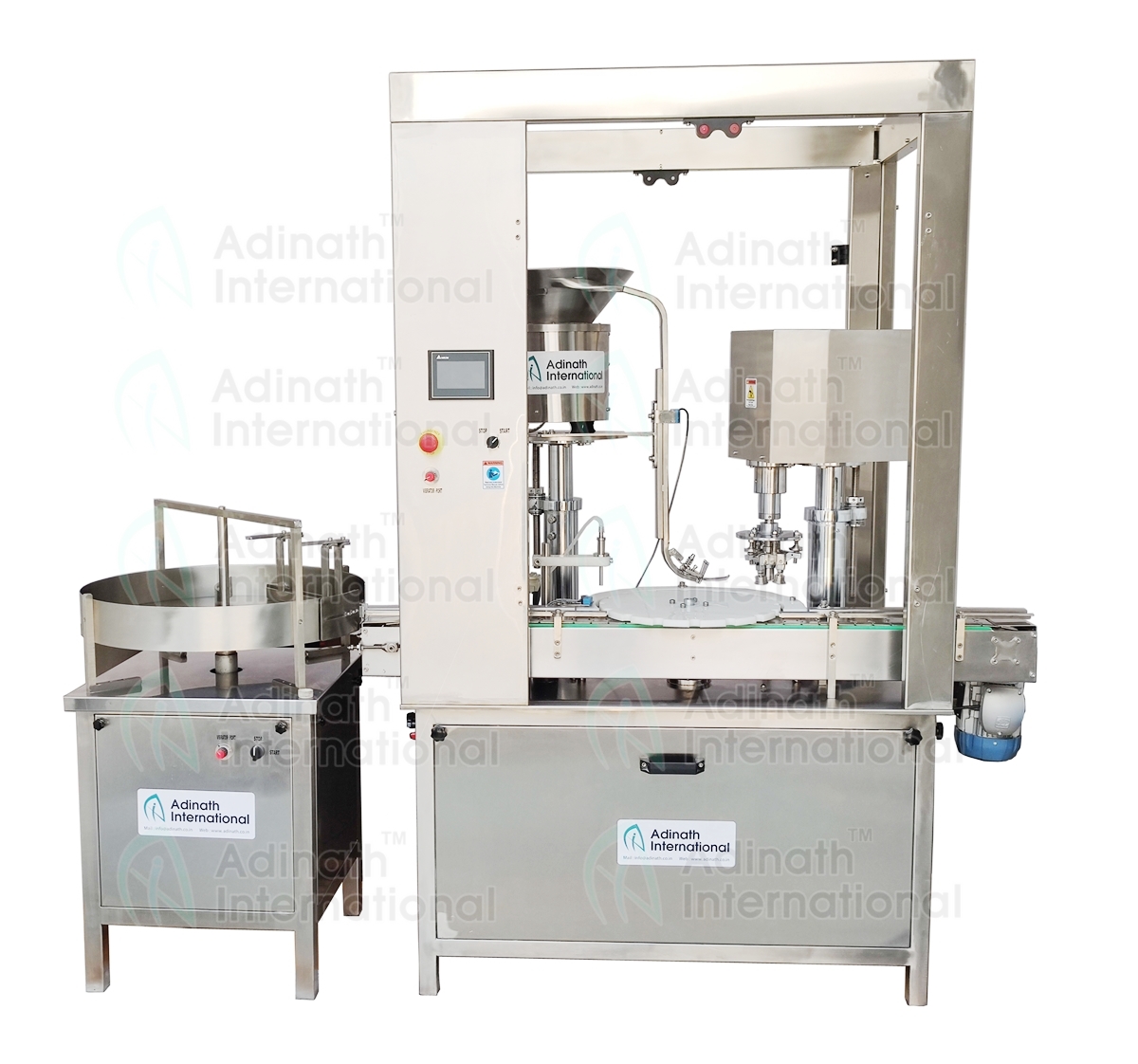
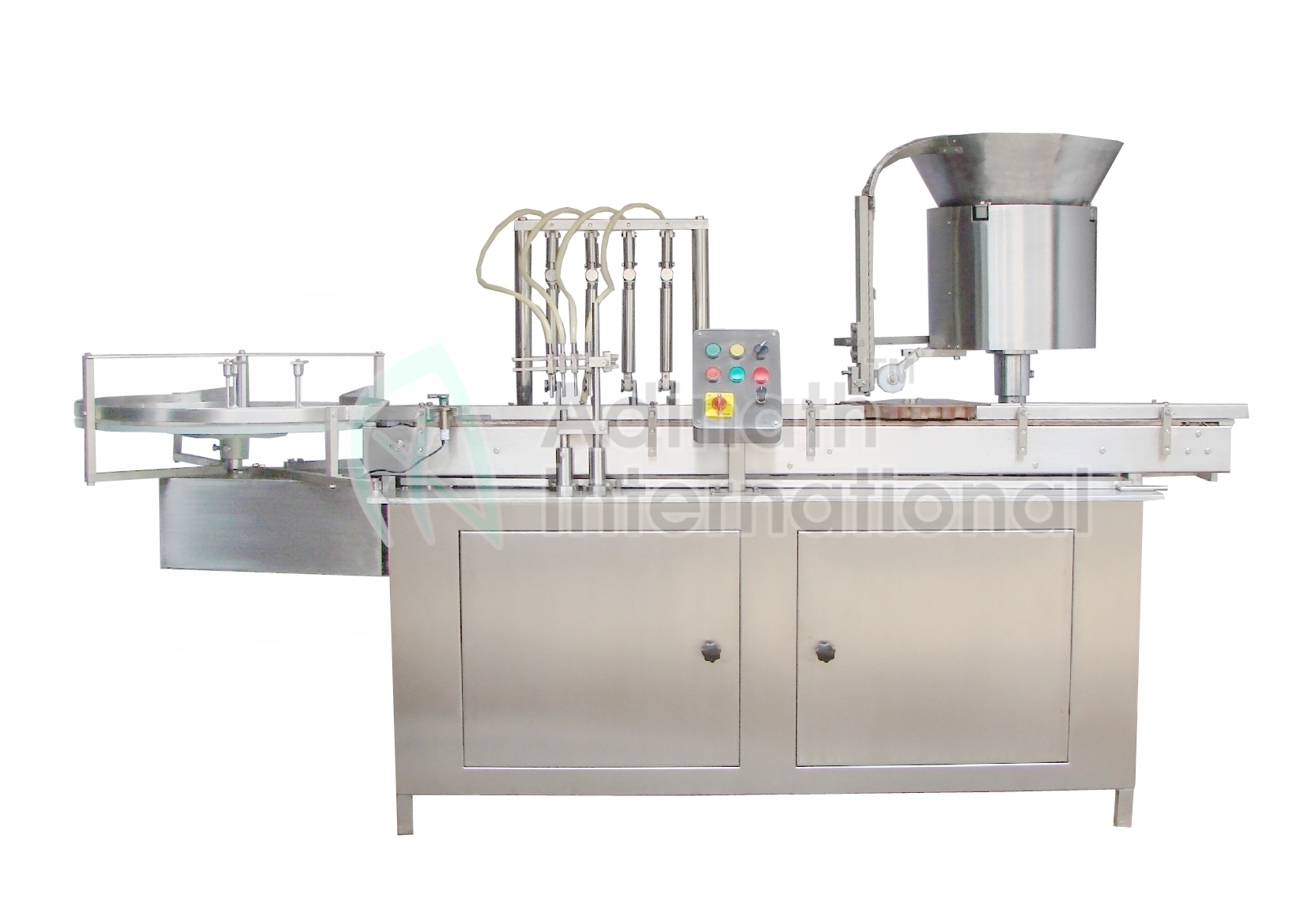
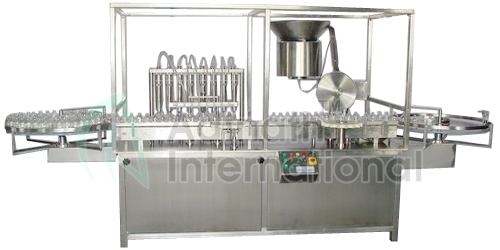
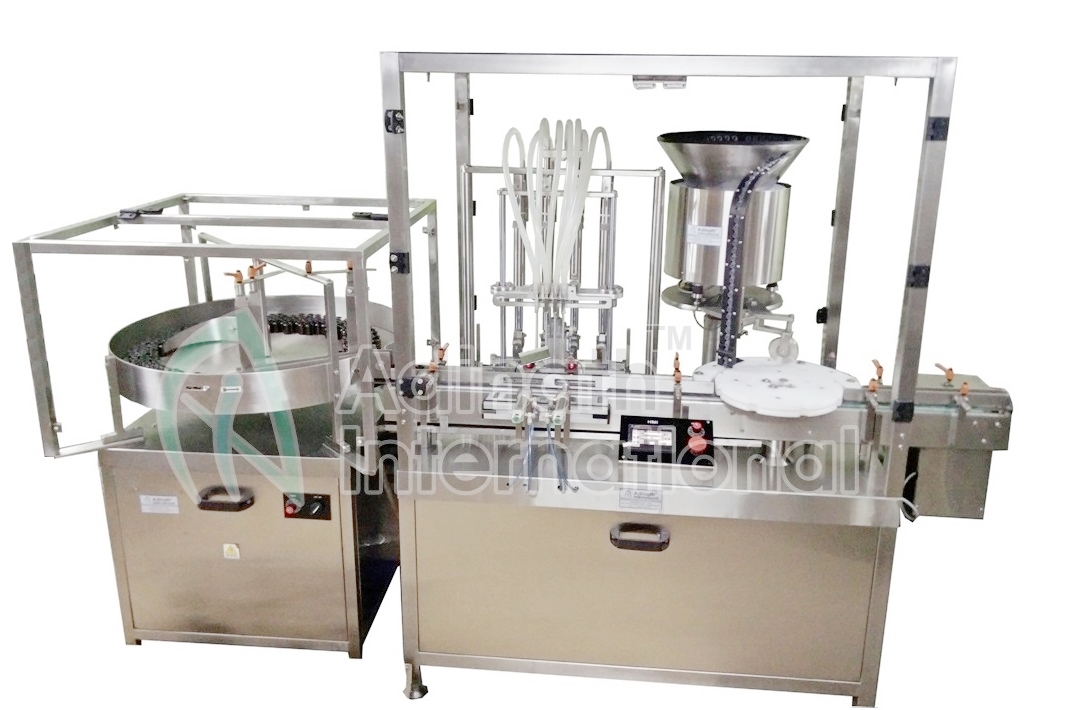
Automatic Vial Filling Stoppering & Capping Machine is made in pleasing matt finished stainless steel materials suitable for filling, rubber stoppering and cap sealing of glass vials. The basic unit consists of turntable, Stainless Steel Stat conveyor belt, unique eccentric pre-gassing, filling and post-gassing. Highly efficient and precision built Stainless Steel 316L Syringes, non- toxic synthetic rubber tubing and easy reach compact panel.
The minimal distance between filling and stoppering units reduces the risk of contamination. The machines are designed for operation in a sterile area and for use under laminar flow protection. The un-scrambler itself has been redesigned to eliminate dead ends and difficult-to-clean spots.
Salient Features of Vial Filling Stoppering & Capping Machine
Process Operation of Vial Filling Stoppering & Capping Machine
The incoming dry vial (sterilized and siliconised) are fed through the unscrambler and suitably guided on the moving delrin slat conveyor belt at the required speed of the correct placement below filling unit. The filling unit consists of Filling Head, Syringes & Nozzles which are used for liquid filling. The syringes are made of Stainless Steel 316L construction and both, glass as well as Stainless Steel syringes can be used. A Star Wheel is provided which holds the vial during filling operation. A sensor is provided for ”No Vial-No Filling” operation. Syringes are mounted on eccentric block and driving through bottom main gear box. Volume can be either increased or decreased by increasing or decreasing stroke length of piston as per filling size. Syringes is having non return valve for sucking and delivering situation to avoid volume variation. Liquid will reach to filling nozzles through silicon transparent pipe. Nozzle will be having Up and Down movement with help of cam mechanism and it will come down when vial will be hold by starwheel for filling operation and starts filling when it starts to move up and after completion of filling operation, starwheel delivers six vials together on conveyor for rubber stoppering operation. Stoppering unit consist of Starwheel, Vibrator unit and Bowl. The sterilized and siliconised rubber stoppers stored in the vibrator bowl moves vertically to the rubber stopper chute. The vial is hold firmly by starwheel, which will be in continuous rotary motion and vial which is coming from filling unit get in to starwheel and move in rotary direction along with starwheel, during movement it will pick up the rubber stopper from the exit end of the chute and rubber stopper will be pressed by fix single pressing roller, which is spring loaded. Then vial further move on sealing station. Aluminium caps kept in vibratory bowl automatically orient caps in right direction before entering the delivery chute. Vial during its rotation movement with infeed starwheel picks up aluminum seal from the retaining finger of delivery chute and correctly position on the vial before entering sealing turret. Vial now moves on the spring loaded sealing platform, where free spinning sealing rollers moves gradually inside to complete the sealing operation during rotational movement of sealing platform turret. Now sealed vials are transferred to exit starwheel pocket and further moves out on to the flat conveyor belt. Duly sealed vials are collected on out-feed collection tray.
Technical Specification of Vial Filling Stoppering & Capping Machine
| Model | ALVF-40 | ALVF-80 | ALVF-120 | ALVF – 250 |
| Filling Heads | Two | Four | Eight | Twelve |
| Production Rate | Up to 40 Vials/Minute | Up to 80 Vials/Minute | Up to 150 Vials/Minute | Up to 250 Vials/Minute |
| Input Specification | ||||
| Vial Diameter | 15mm to 70mm | 15mm to 70mm | 15mm to 70mm | 15mm to 70mm |
| Vial Height | 25mm to 140mm | 25mm to 140mm | 25mm to 140mm | 25mm to 140mm |
| Filling Precision | ±1% | ±1% | ±1% | ±1% |
| Power Required | 1 H.P. | 1.5 H.P. | 2 H.P. | 2 H.P. |
| Electrical Characteristics | 440 Volts, 3 Phase, 50 Hertz | 440 Volts, 3 Phase, 50 Hertz | 440 Volts, 3 Phase, 50 Hertz | 440 Volts, 3 Phase, 50 Hertz |
| Overall Dimension | 2050mm (L) x 850mm (W) x 1700mm (H) | 2200mm (L) x 850mm (W) x 1700mm (H) | 3000mm (L) x 945mm (W) x 1700mm (H) | 3500mm (L) x 945mm (W) x 1700mm (H) |
* Power voltage can be adjusted as per customer’s domestic power voltage requirements.
* Rights of technical improvements & modification reserved.
* Illustrations & dimensions are shown for information purpose only.
FAQ of Vial Filling Stoppering & Capping Machine
What vial sizes and filling volumes does the machine support?
The machine typically handles vials with diameters of 15mm to 70mm and heights of 25mm to 140mm. Filling volumes range from 2ml to 250ml (or up to 100ml in some monoblock models), with precision of ±0.5% to ±1%.
What are the available models and their production capacities?
Adinath offers models with 2, 4, 8, or 12 filling heads. Production rates range from up to 40 vials/min (2-head) to up to 250 vials/min (12-head), suitable for small, medium, and large batch production.
What filling mechanisms are available and what is their accuracy?
It uses stainless steel piston pumps (standard) or peristaltic pumps (optional) for aseptic filling. Peristaltic options offer CIP/SIP capability, suck-back to prevent dripping (good for oil-based liquids), and high accuracy of ±0.5-1%.
Does the machine comply with cGMP and regulatory standards?
Yes, it features SS 316L contact parts, SS 304 framework, no cross-contamination design, and full cGMP compliance. IQ/OQ documentation is available, with selected variants meeting US FDA and EU GMP guidelines.
What safety and efficiency features does it include?
Key features include “No Vial – No Filling,” “No Vial – Machine Stop,” variable AC frequency drive for speed control, digital vial counter, in-feed turn table/unscrambler, and independent head operation for continuous production.
How does the stoppering and capping process work?
Vials are filled, then move to a vibratory bowl and chute for oriented rubber stoppers (with pressing roller; half-stoppering possible). They then proceed to the capping/sealing station for secure aluminum cap application, often in a monoblock setup.
Can the machine be integrated into a full production line?
Yes, it integrates seamlessly with vial washing machines and cap sealing machines to form a complete online sterile vial filling line, minimizing manual handling and contamination risks.
What materials are used in the machine construction?
All product contact parts are AISI SS 316L stainless steel for compatibility and easy cleaning. The framework uses AISI SS 304, with high-quality components like FESTO pneumatics and CE-approved electrics.
What power requirements and optional features are available?
Power ranges from 1 H.P. to 2 H.P. (440V, 3 Phase, 50 Hz; customizable). Options include PLC with HMI/GUI, PRIME function for priming/cleaning, and enhanced bung handling for wet stoppers.